Businesses are looking for new, better ways to make things simpler, lessen mistakes, and achieve more in today’s fast-growing world of technology. There are two ways to do this: through AI-powered workflow automation or traditional workflow tools. Deciding on a useful solution for your project can be strongly assisted by figuring out the ways in which these two choices differ from one another in the debate of AI vs traditional automation.
What Are Traditional Workflow Tools?
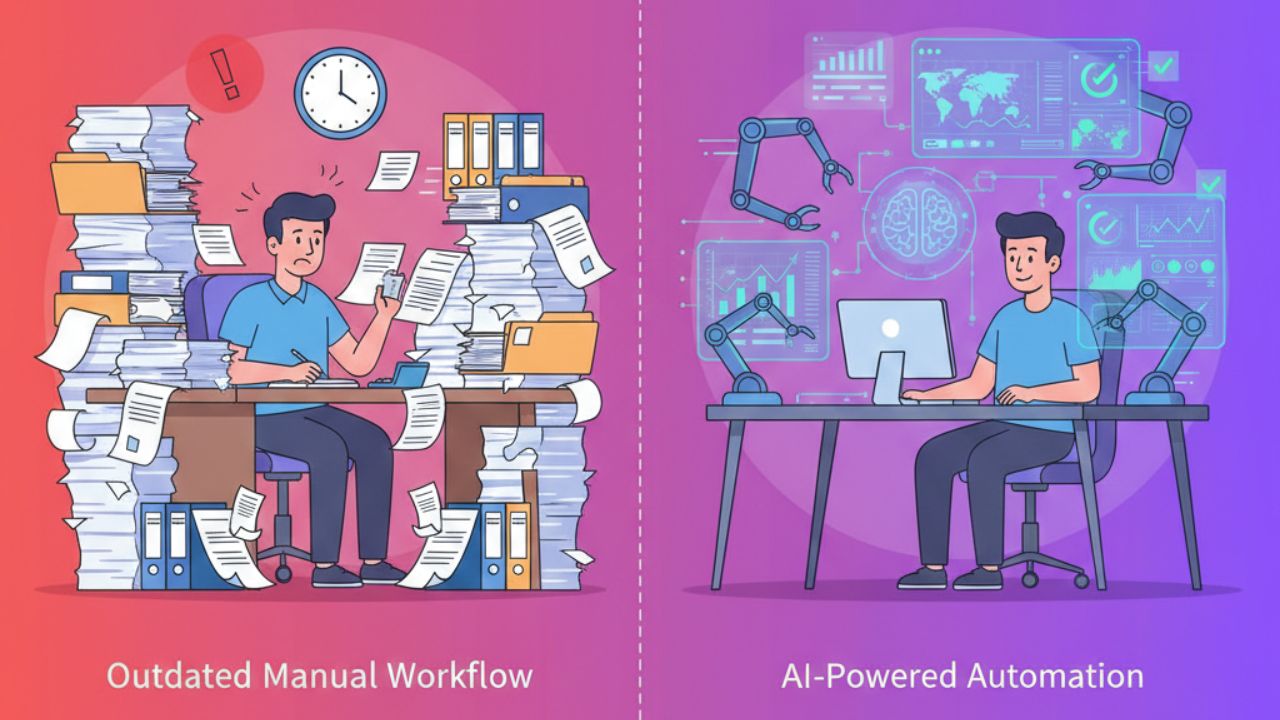
Traditional workflow management systems, which are normally referred to as Traditional workflow tools, have rules to follow and can perform repetitive and time-consuming tasks. They accomplish this by completing several duties, such as approving a receipt when it is more than a certain value. However, traditional workflow management tools do not have flexibility and error understanding, which is a limitation as discussed in AI vs traditional automation.
What Is AI-Powered Workflow Automation?
The major difference between process automation and artificial intelligence (AI) is that AI includes the knowledge of technology. By utilizing linguistic intelligence and machine learning, AI is different from usual automation in its ability to learn, make decisions, and enhance or develop. Another big difference is the fact that AI is able to handle complex data, see, and react to unexpected situations on its own. AI is thus the best choice.
Key Differences Between AI and Traditional Workflow Tools
These new AI tools for work organization are intelligent, fast, and flexible compared to Traditional workflow tools.
1. Decision-making
Decisions are made dynamically by AI tools depending on the results obtained from data analysis, while traditional tools make decisions relying on static rules.
2. Learning and improvement
New AI tools are always enhanced with the addition of new data, while Traditional workflow tools are unable to learn and develop.
3. Handling errors and exceptions
Although the AI technology can automatically detect and correct errors, the traditional methods require human involvement in correcting errors that occur.
4. Data Processing
Unlike the traditional methods, which can only process structured data, AI technologies can process both structured and unstructured data.
5. Flexibility and Scalability
Unlike the AI technologies, which can easily scale with the availability of more data, the traditional methods can fail in the event that a change occurs unexpectedly.
All these factors directly affect efficiency, accuracy, and business outcomes when comparing AI to traditional automation.
Why AI Automation Excels
Increases productivity, lessens delays, and streamlines repetitive business operations effectively.
- Smarter decision-making: AI looks for patterns and makes processes better, faster.
- Handles complexity: AI understands messy information such as emails, documents, or messages.
- Continuous improvement: AI enhances by understanding from its experiences.
- Reduced mistakes: AI finds mistakes that traditional rules overlook.
- Scalable efficiency: AI gets better as you have more data, so there’s less need for updating and cost.
When Traditional Tools Make Sense
These tools remain useful when:
- Tasks are highly repetitive and predictable.
- Processes require strict compliance or audit trails.
- Budget or technical expertise is limited.
In these circumstances, regular means offer a simple and inexpensive solution for automation.
The Best of Both Worlds: Hybrid Workflow Automation
Organizations often have a combination of regular means of working and artificial intelligence technology.
- For regular means, there are fixed and expected processes.
- For AI, there are problems, decisions, and data understanding.
This combination of approaches offers a balance of reliability and smart technology, allowing people to work better and making the most of the advantages of AI vs traditional automation.
How Gen6 Intelligence Enhances Your Workflows
At Gen6 Intelligence, our AI-powered workflow automation solutions are designed to:
- Integrate with existing systems and legacy tools.
- Learn from your business data to improve accuracy.
- Reduce cost and manual oversight.
- Optimize work processes in real time.
Whether you’re automating customer support routing, order processing, or internal reporting, Gen6 Intelligence systems adapt and grow with your needs, not just execute fixed rules.
Conclusion
This would bring efficiency, flexibility, and decision-making capabilities in the future. But for simple and predictable processes, traditional workflow management tools are good. Both are required for a business to thrive in a digital world, and your organization can do so with the help of Gen6 Intelligence.
FAQs
How is AI workflow automation different from traditional automation?
AI has the ability to learn and adapt, while traditional automation only has the ability to perform in accordance with a set of rules.
What are the 4 different types of automation?
Fixed automation, programmable automation, flexible automation, and intelligent automation.
What is the primary difference between AI and traditional software?
AI has the ability to analyze data and learn, while traditional software only has the ability to perform a series of instructions.
Is AI a type of automation?
Yes, AI has the ability to perform intelligent automation.
When should a business implement AI workflow automation?
A business should implement AI workflow automation when the processes involved are complex and data-driven.