Recruitment automation uses AI and software to do the day-to-day hiring tasks and responsibilities, such as screening CVs, scheduling candidate interviews, and other day-to-day follow-ups, with some kind of manual effort. Businesses that can use it hire faster, spend less, and find better candidates.
What Is Recruitment Automation?
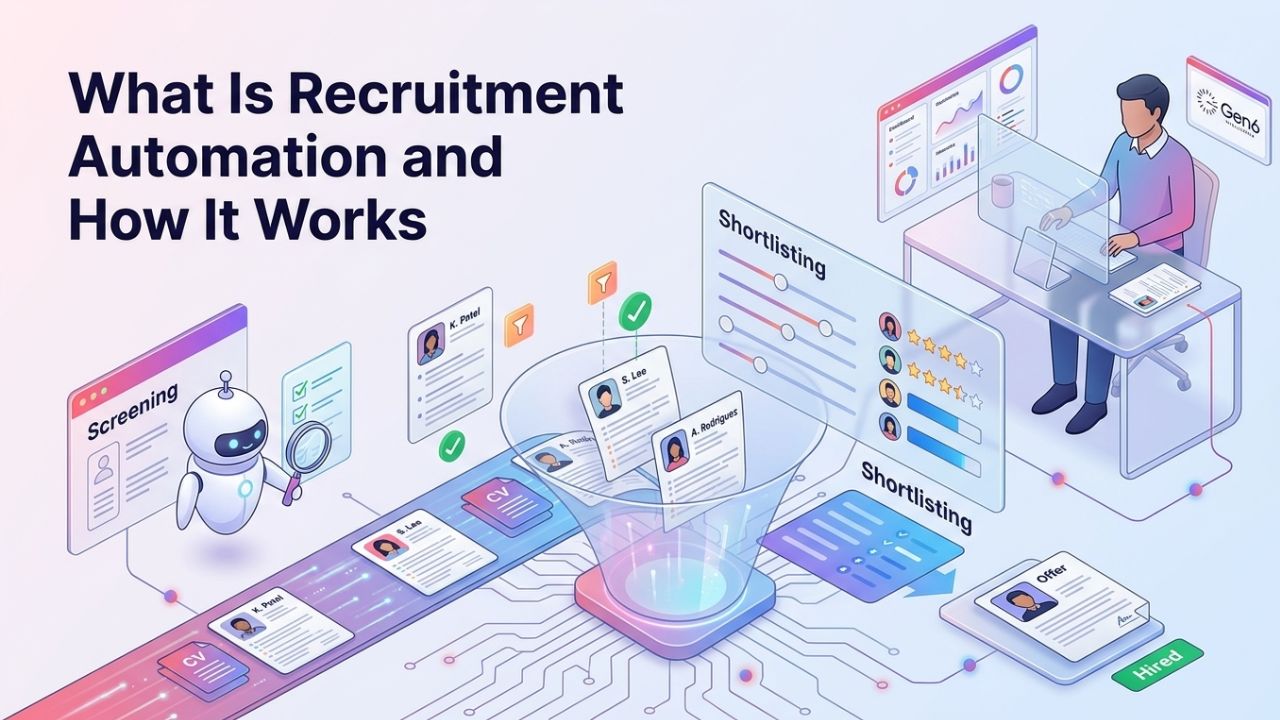
Recruitment automation is about using software to run hiring tasks without doing them manually every time. It is not about removing people from hiring. It is more about eliminating the repetitive work that slows people down. The system automatically sends a confirmation email when a candidate applies, for instance, scores the CV as per your criteria, and moves the best matches to a shortlist, all without anyone touching a keyboard.
Why Hiring Is Broken for Most Businesses
Hiring often feels slow, manual, and frustrating for growing teams.
- Job posts receive 200+ applications
- Manual resume reviews waste hours
- Scheduling interviews takes days
- Delayed offer letters
- Teams remain understaffed
- Business growth slows
Recruitment process automation has that ease and prevents delays, helps at every stage, and lets your team focus on human decisions, not repetitive tasks.
How AI Recruitment Automation Actually Works
The process runs in stages. Each stage connects to the next automatically. The system publishes your vacancy across multiple job boards at once. No manual uploads. No repeated copy-pasting.
- Step 1: Application collection. All applications flow into one dashboard. The system parses each CV and extracts key information, skills, experience, location, and qualifications.
- Step 2: Scheduling: Shortlisted candidates receive a link to book their own interview slot. No back-and-forth emails. No missed calls. Calendars sync in real time.
- Step 3: Communication: Every candidate gets timely updates. Status changes trigger automatic messages. No one is left wondering where they stand.
- Step 4: The system tracks time-to-hire, source of hire, drop-off rates, and offer acceptance rates. You see exactly where your process works and where it does not.
This is what automated candidate screening looks like end-to-end. Each stage feeds the next. Nothing falls through the cracks.
Which Hiring Tasks Can Be Automated?
Most of the repetitive work in recruitment is a strong candidate for automation. Your team spends hours on tasks that software can handle in seconds. Here is exactly what you can hand off:
- Job posting: publish your vacancy across multiple job boards in one click
- CV screening: AI scores each application against your job criteria instantly
- Candidate ranking: shortlists are done automatically, and the best one rises to the top
- Reference checks: automated request emails and follow-up reminders
- Offer letters: generated and sent with a single click
- Reports: real-time dashboards with no manual data entry
The tasks that still require a human are the ones that matter most. Interviews, final decisions, salary negotiation, and onboarding conversations stay with your team. Automation handles everything else, so your recruiters spend their time on people, not paperwork.
Manual Recruitment vs Recruitment Automation
Recruitment methods have transformed significantly, with businesses just shifting from traditional hiring processes to technology-driven software solutions for improved efficiency.
| Aspect | Manual | Automated |
| Screening | Manual resume review | AI-based filtering |
| Scheduling | Email coordination | Auto-scheduling |
| Speed | Slower hiring | Faster process |
| Spreadsheets | Spreadsheets | Centralized system |
Recruitment automation streamlines hiring, reduces time-to-hire, and improves overall efficiency compared to manual processes.
Benefits of Recruitment Automation for Companies
The gains are real and measurable.
- Faster hiring. Companies using AI hiring platforms cut their time-to-hire by 40 to 60 per cent on average. Roles that took six weeks to fill now take two.
- Lower cost per hire. Less manual work means less staff time per vacancy. That adds up quickly when you hire at volume.
- Better candidate quality. AI screening removes bias from the first filter. The system scores on skills and not on how a CV is formatted or which university someone attended.
- Consistent candidate experience. Every applicant gets the same timely, professional communication. That protects your employer brand even with the people you do not hire.
- Reduced admin load. Your recruitment team stops spending 70 per cent of their time on admin. They spend it on conversations, assessments, and closing strong candidates.
- Real hiring data. You stop guessing. You see which job boards generate the best hires, which roles take longer to fill, and where candidates drop off in your process eventually.
For growing businesses, these gains are not optional extras. They are the difference between scaling your team and falling behind on headcount.
How to Choose Automated Hiring Software
Automated hiring software systems are quite simple to use. First, confirm it to allow it into your calendar, email, and existing HR recruitment software. Make sure you can set role-specific screening tasks that are aligned with the UAE compliance, including MOHRE requirements.
Test the candidate experience; if it feels clunky, applicants will drop off. Finally, check the reports so you can spot the backlogs and track time-to-hire. The right platform saves hours each week and pays off quickly. Solutions like Gen6 Intelligence help simplify recruitment without adding technical complexity.
Can Recruitment Automation Reduce Hiring Time?
Yes, and the data backs it up. Manual hiring is slow by design. Every stage waits on a person. CV review waits on HR. Scheduling waits on the hiring manager. Offer letters wait on legal sign-off.
Automation removes most of those waits. Screening happens in seconds. Scheduling happens in minutes. Communication happens instantly. Speed matters because the best candidates are off the market in 10 days or less. A slow process does not just waste time; it costs you the people you most want to hire.
Conclusion
Recruitment automation has to help companies make hiring faster and more efficiently. It reduces a lot of effortful manual work, helps with candidate communication, and guides HR teams to focus on having the right talent. When used well, it enables them to make better hiring decisions and a smoother recruitment process.
Start using recruitment automation to hire faster and smarter.
FAQs
What is recruitment automation?
A: Recruitment automation enables software to manage all the repetitive tasks like CV screening, interview scheduling, and reporting effectively by saving extra time.
How does AI recruitment automation work?
A: AI recruitment automation is more about utilising the key data, matching candidates’ profiles to get requirements, ranking the applicants, and then it helps with the next step.
What are the benefits of recruitment automation for companies?
A: Companies benefit from faster hiring cycles, reduced recruitment, stronger candidate shortlists, more consistent communication, and significantly less manual workload for recruiters.
Which hiring tasks can be automated?
A: Common automated tasks are job distribution, CV screening, interview scheduling, candidate status updates, rejection emails, offer letter generation, and hiring dashboard analyses.
What are the best recruitment automation tools?
A: The tools easily integrated into your existing ATS and HR stack, support local compliance requirements, keep the candidate experience simple, and have the reporting that guides you to upgrade hiring feedback.