
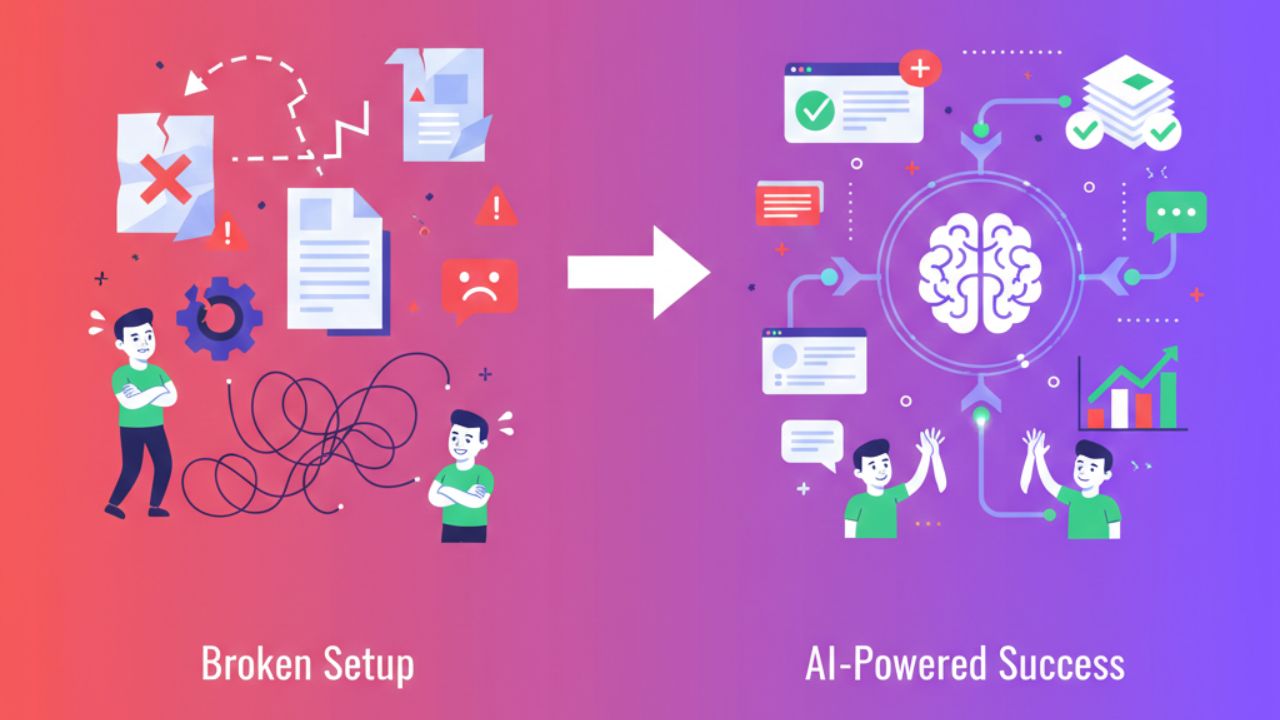
Companies contribute to automation to extend productivity, reduce costs, and decrease mistakes. However, many automation projects don’t add value. Although automation promises faster business processes, many projects fail to deliver high ROI or fail shortly after implementation. This pattern of Automation project failure is common across industries. The primary reason for this is straightforward: most projects are technology-centric, rather than strategy, process, and people-centric.
A strong foundation is essential for success, even with the best technology. This is where AI-powered intelligent automation fills the gaps that traditional automation can overlook and drives AI automation success.
Why Automation Projects Fail
Automation projects promise efficiency, cost savings, and mistake reduction. However, many projects fail to deliver. The following are the primary reasons why automation projects fail:
- Poor Automation Strategy
Lack of a genuine business need, organisations also automate processes because it is the latest trend. This results in a Poor automation strategy, leading to patchy implementations, inefficient use of resources, and lost potential.
- Automating Inefficient Processes
Automated processes can diminish and become error-prone. The process needs to be optimized before automation, or AI-driven optimization opportunities will be missed.
- Lack of Change Management
New technology is also resisted by the organisational workforce. The adoption level is low, and the technology is underutilised if proper Change management is not applied.
- No Clear Metrics
Success cannot be measured in projects that lack clear measures, such as time saved, errors reduced, or adoption rates, which limits the potential for AI automation success.
- Siloed Teams
Automation also involves more than one department. When teams work independently, they can create problems like inconsistent results, redundant work, and a lack of responsibility, weakening Intelligent automation initiatives.
- Technical Fragility
If data formats are altered or systems are upgraded, rule-based automation is likely to fail. Projects that lack long-term plans for maintenance are bound to fail and disappoint, especially without AI-driven optimization in place.
How AI Fixes Automation Failures
Automation is made smarter and more flexible by AI, which assists it in accomplishing tasks that are not possible in traditional automation. AI has ended up more than a tool presently and plays a vital role in AI automation success.
- Intelligent Automation
Intelligent automation has the capability to process unstructured data, identify designs, and execute tasks that require human intelligence.
- Continuous Learning
AI can monitor its performance, learn from mistakes, and upgrade over time without breaking the bank or making numerous mistakes. It can progress on its claim through AI-driven optimization.
- End-to-End Workflow Automation
Intelligent automation can automate complex tasks like acting on context and making predictions.
- Improved Change Management
When AI solutions are transparent and open to their input, individuals are more accepting of automation and new technology, strengthening overall Change management efforts.
Best Practices for AI-Driven Success
It is not only necessary to deploy the tools but also to plan and develop for the successful implementation of AI-based automation. Here’s how you can assure adoption and maximize ROI:
- Set Up Clear Goals Initially: Set up clear goals that include measurable results like improved client satisfaction, fewer mistakes, and quicker processing, avoiding a Poor automation strategy from the beginning.
- Select High-Value Operations: To maximize ROI, prioritize high-volume, repetitive business processes.
- Define Metrics Directly: Regularly track performance, adoption, and efficiency to ensure the project stays on track and to support long-term AI automation success.
- Employee Engagement at an Early Stage: To avoid resistance, train employees, communicate with them, and connect them in the process through structured Change management practices.
- Use AI Optimization: Utilize AI to monitor processes, automatically correct and reduce errors, and optimize performance with continuous AI-driven optimization, preventing issues caused by a Poor automation strategy.
Conclusion
Automation projects often fail, though they can be ended. It is imperative to coordinate planning, process optimization, alter management, and automation by AI to succeed. They can optimize their processes, expand without issues, and accomplish measurable results in this way. Consequently, automation will not be a utility for them but will allow them a competitive advantage. With the right AI strategy and support from Gen6 Intelligence, businesses can turn automation challenges into long-term, scalable success.
FAQs
What are the problems with AI automation?
Problems with data quality, strategy, cost, integration, and change management.
What is a common reason for an AI project failing?
Lack of clarity on objectives, data readiness, and alignment with stakeholders.
What happens when automation fails?
Unspent budget, low ROI, dissatisfied employees, and loss of confidence among stakeholders.
What is intelligent automation with the use of AI?
Automation systems that use AI to learn, improve, and optimize processes beyond rule-based automation.
What is the biggest challenge in automation?
Integration of technology with business strategy, processes, and employee adoption.