Most companies are not aware of the frequency of accounting mistakes. The money records can be affected by errors in manual entry, duplicate bills, bills that have not been approved, and discrepancies during the reconciliation process. Small errors can lead to poor decisions, financial problems, and legal problems. This is where the application of AI in accounting procedures and AI in accounting workflows is changing the way financial teams operate.
Companies are using smart technology to minimize risks and optimize financial management rather than depending mainly on manual reviews and routine tasks. Gen6 Intelligence helps organizations implement AI-driven accounting automation to reduce errors and strengthen financial control.
Why Errors Happen in Traditional Accounting
It is significant to know where mistakes usually happen before understanding how AI assists:
- Manual data entry.
- Spreadsheet dependency.
- Delayed reconciliations.
- Inconsistent approval processes.
- Human oversight during audits.
Traditional accounting automation reduced workload but still relied on rule-based systems. These systems only follow predefined instructions. They cannot detect unusual patterns or adapt to changing scenarios. Contemporary AI-based solutions are the answer to this gap and enable better error reduction with AI.
1. Smarter Data Entry and Invoice Processing
A key factor that causes discrepancies in accounting is wrong data entry. Artificial intelligence systems can automatically extract data from invoices, receipts, and financial statements utilizing intelligent computer technology.
With advanced accounting automation solutions:
- Duplicate invoices are flagged immediately.
- Missing fields are automatically detected.
- Vendor details are verified against records.
- Entries are categorized correctly.
This significantly improves the effectiveness of error prevention by AI and supports error reduction with AI by getting rid of the need for manual re-entry, which is prone to errors.
2. Automated Reconciliation with Real-Time Validation
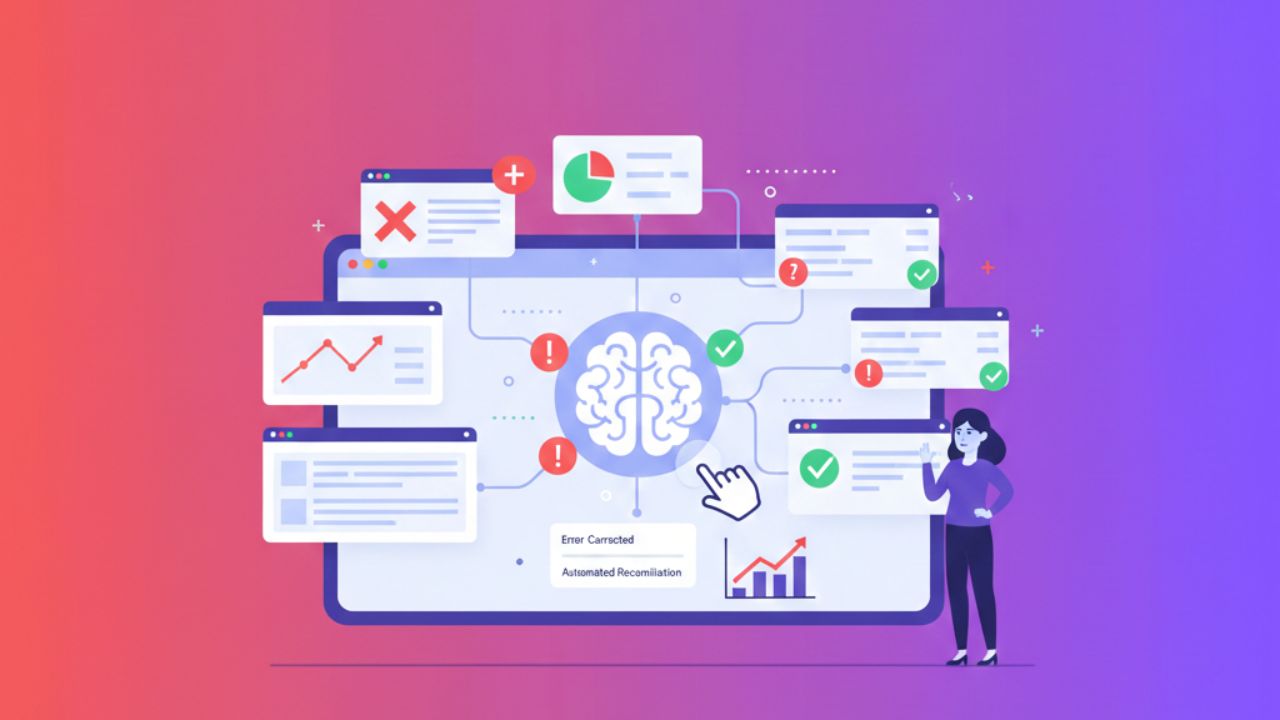
An error in reconciliation can result in unstable books and delayed reporting. AI systems continuously compare transactions across bank statements, ERP systems, and accounting platforms.
Instead of checking records at the end of the month, financial automation:
- Real-time matching of transactions.
- Alerts for errors are sent immediately.
- Finalizing the end-of-month process takes less time.
- Decreased the number of overdue reconciliations.
In this way, companies can avoid problems from becoming bigger problems and achieve stronger error reduction with AI.
3. Intelligent Anomaly and Fraud Detection
AI models analyze data trends based on the history of transactions, which is not basic automation. It identifies unusual spending behavior, duplicate payments, or irregular vendor activity.
AI auditing systems can:
- Flag suspicious transactions.
- Detects outliers compared to historical data.
- Identify policy violations.
- Lower the chance of fraud both within and outside the business.
This level of monitoring significantly upgrades financial management and boosts trust in the integrity of financial reporting while strengthening AI auditing capabilities.
4. Continuous Audit Support
Traditional audits are periodic. AI auditing tools enable continuous monitoring. AI analyzes transactions in real-time, as opposed to analyzing them after they occur.
This helps organizations:
- Ensuring constant compliance.
- Make it easier to prepare for the audit.
- Ensure the documents are accurate.
- Minimize the risk of penalties from the relevant authorities.
AI enhances the accuracy and clarity of accounting procedures; it does not assume the role of auditors and supports financial automation across departments.
5. Reduced Dependency on Spreadsheets
The main causes of accounting problems are formula discrepancies and differences in versions of spreadsheets. Financial automation using AI technology minimizes the use of fragmented technologies by integrating data from multiple systems into one system.
When data is seamlessly transferred from one system to another:
- There are fewer duplication errors.
- Automatic generation of reports is enhanced.
- Financial forecasting becomes more accurate.
- Decision-making improves.
The Human + AI Advantage
Although AI is able to identify hidden risks and remove repetitive work, intuition is still required. Finance experts are concerned with analysis, planning, and decision-making, while AI is responsible for validation and monitoring supported by accounting automation.
Its balanced strategy ensures:
- Higher financial accuracy.
- Faster reporting cycles.
- Lower compliance risks.
- Improved confidence in financial data.
Conclusion
AI is more than a productivity aid; it is an important enabler of financial accuracy. With AI, intelligent data processing, real-time reconciliation, AI auditing, and fraud analysis are now possible, which has greatly minimized errors and improved financial operations. Improved compliance, rapid reporting, and long-term operational resilience are all characteristics of organisations that have automated accounting, human review, and high internal standards. The application of AI in financial operations is crucial for accurate accounting and sustained growth as the business expands in size. With the right implementation strategy from Gen6 Intelligence, businesses can build error-resistant, scalable accounting workflows powered by AI.
FAQ’s
How does AI help with workflow?
AI automates repetitive tasks, validates data in real time, and reduces manual intervention.
How does AI minimize errors?
AI detects duplicates, flags anomalies, and verifies transactions against historical patterns automatically.
How is AI used in accounting?
AI handles invoice processing, reconciliation, fraud detection, forecasting, and continuous audit monitoring.
What is the role of artificial intelligence in eliminating accounting errors?
AI improves data accuracy, ensures compliance, and prevents discrepancies through intelligent validation systems.
How is AI used in accounting and auditing?
AI monitors transactions, identifies risks, supports compliance, and enables continuous auditing processes.