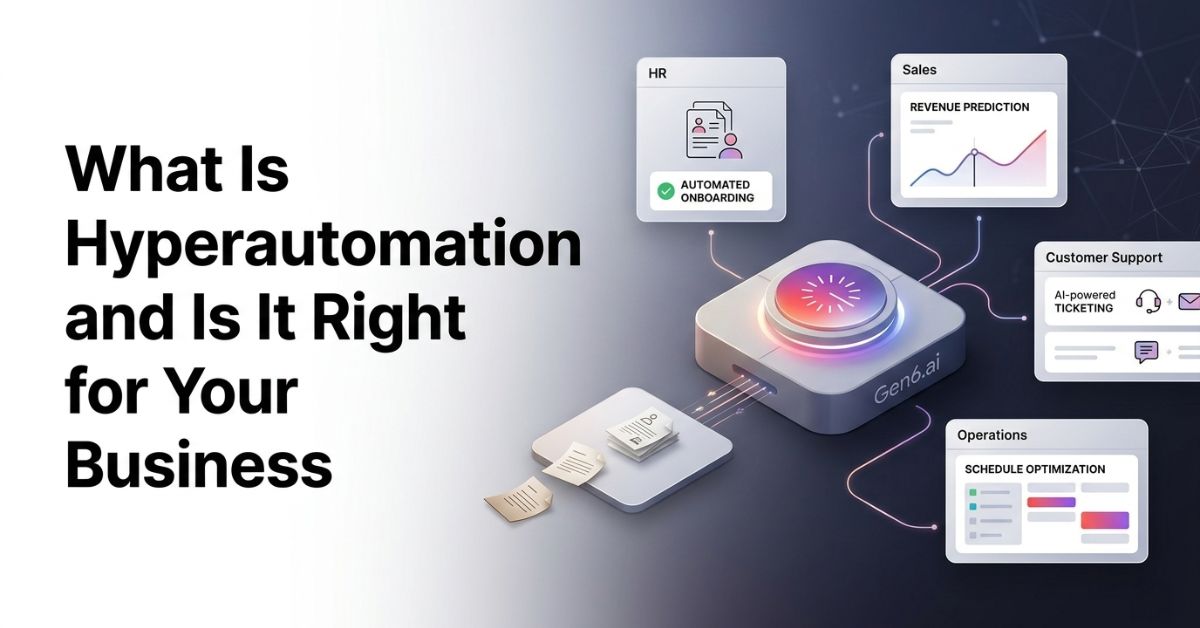
To remain competitive, it requires more than task switching. The concept of what is hyperautomation will define the future with the incorporation of artificial intelligence along with seamless business processes. Hyperautomation does not require a choice whether to use automation or not, but it requires an extent of how much automation can be utilized in core processes. Now, let us discuss how the ability of your firm could change due to replacing manpower with smart technologies.
What is Hyperautomation and Why Does It Matter?
Hyperautomation helps streamline business processes by leveraging automation tools, machine learning, and artificial intelligence. This helps reduce manual work and makes everything more efficient. This combination of RPA and AI automation helps make AI business process automation faster and more accurate.
- Smart Integration: Links CRM and accounting together for a smooth and automatic process.
- AI Discovery: Automatically identifies and corrects problems in processes using special data analysis techniques.
- Cognitive Power: Helps to make tough choices and deal with messy information through AI business process automation.
- Rapid Scale: This allows end-to-end automation in the business by eliminating any bottlenecks that arise from human operations.
Hyperautomation vs. Regular Automation: Key Differences
The main difference between hyperautomation and normal automation lies in the concept of “intelligence.” Normal software follows set instructions: “If this occurs, then do this.” Intelligent automation is applied in hyperautomation for automatic decision-making and problem-solving. Making the right decision through the understanding of AI process automation vs. traditional automation.
| Feature | Traditional Automation | Hyperautomation |
| Scope | Single task or process | Entire business workflows |
| Technologies | Rule-based scripts/RPA | AI + RPA + ML + NLP + Process Mining |
| Human Intervention | Required for exceptions | Near-zero with intelligent decisions |
| Scalability | Limited to specific silos | Enterprise-wide, cross-department |
| Platform Example | Basic task schedulers | Gen6 AI Workflow Automation |
Core Technologies That Power Hyperautomation
To achieve end-to-end automation from start to finish, you need both a “brain” and “hands. ” To create an effective hyperautomation system, you need these four key parts working together:
- RPA and AI Automation: While RPA performs tasks repeatedly like someone’s hands, AI functions like the mind to comprehend something like an email or an image.
- Intelligent Automation (AI/ML): The machine learning method assists the workflow automation software in learning from past data and refining its operations with time.
- Process Mining: Give insights into the processes and enhance end-to-end automation effectiveness.
- Low-Code Platform: Examples of low-code platforms include Gen6 AI, which enables even non-tech-savvy users to use advanced technology platforms.
Top Benefits of Hyperautomation for Businesses
The primary goal of AI business process automation is to free your human talent for creative and strategic work. When you remove the “drudge work,” the impact on your bottom line is immediate.
| Benefit | Business Impact |
| Cost Reduction | Eliminates manual labor hours on repetitive data entry. |
| Speed & Accuracy | Workflows run 24/7 with near-zero human error rates. |
| Scalability | Scale HR, Sales, and Support without hiring more staff. |
| Customer Experience | Instant response times and personalized service delivery. |
| Agility | Quickly pivot workflows to match 2026 market demands. |
Real-World Example: Marketing agencies using Gen6 have reported cutting campaign setup times from weeks to hours by automating lead scoring and content distribution cycles using workflow automation software.
Common Challenges (And How to Overcome Them)
Implementing hyperautomation can be difficult in practice. Almost all competing firms ignore the “human aspect,” which is a primary reason why most automation projects fail, and how an AI solution can bridge that gap.
- Data Quality: If the data is not centralized or organized, then your intelligent automation will not work efficiently.
Solution: Use process mining to organize your data before automating it.
- Tool Overload: Many companies buy several automation tools that don’t work together.
Solution: Use a unified workflow automation software, serving as the central point of everything.
- Change Management: Employees tend to fear that AI might replace them at work.
Solution: Stress on the word “augmentation” and teach your employees how RPA and AI automation would benefit them by relieving them of unpleasant tasks like writing reports and booking appointments.
Is Hyperautomation Right for Your Business?
Hyperautomation is now something that all businesses can use, not just big companies. This trend is particularly evident in global tech hubs where the future of work in the UAE is being redefined by AI automation to drive economic efficiency. If you see any of these signs, it’s time for full AI business process automation:
Signs You’re Ready:
- Your team dedicates 5 or more hours per week to manually entering data.
- Your responsibilities include managing workflows within two or more departments.
- Manual mistakes are causing client churn or compliance risks.
Self-Assessment Checklist:
- Do you have repetitive tasks that “drain” your staff’s energy?
- Are you looking to scale without hiring 10 more people?
- Do you have multiple apps (CRM, Slack, Email) that don’t talk to each other?
If you checked 2 or more, workflow automation software is no longer an “option”—it’s a necessity for survival in 2026.
How Gen6 AI Delivers End-to-End Automation
Gen6 Intelligence is designed to bridge the gap between complex technology and human-friendly workflows. We offer a simple place where intelligent automation is easy to use.
- Describe: Let Gen6 know what you want to achieve using plain English.
- Connect: Within minutes, connect all of your existing applications, such as Gmail, Slack, and CRMs.
- Launch: The AI agents will handle all the rest either according to a predefined strategy or dynamically depending on what unfolds.
Whether you’re automating onboarding or dealing with high volumes of lead generation as part of your sales process, Gen6 has the RPA and AI automation solutions you require for your self-sustaining organization.
Conclusion
The most important strategy that will help you succeed in 2026 is hyperautomation. By combining artificial intelligence, RPA, and process mining, there will be several ongoing actions that keep improving themselves. No more wasting time on manual work. Make the transition to automation today and reach critical goals.
FAQs
1. What is hyperautomation?
It is a technology-enabled ecosystem that automates complex, end-to-end business processes without any human intervention.
2. What is the difference between hyperautomation and RPA?
Hyperautomation leverages AI to perform non-repetitive tasks involving decision-making, whereas RPA deals with repetitive tasks.
3. Is hyperautomation only for large enterprises?
No, hyperautomation is available for everyone because of intelligent scalability through low-code solutions.
4. How do I know if my business is ready for hyperautomation?
If manual entry and disconnected applications are hindering business growth, then you can use hyperautomation.
5. What are real examples of hyperautomation in business?
Automating whole marketing funnels, touchless invoices, and AI-based hiring procedures are good examples of such automation.