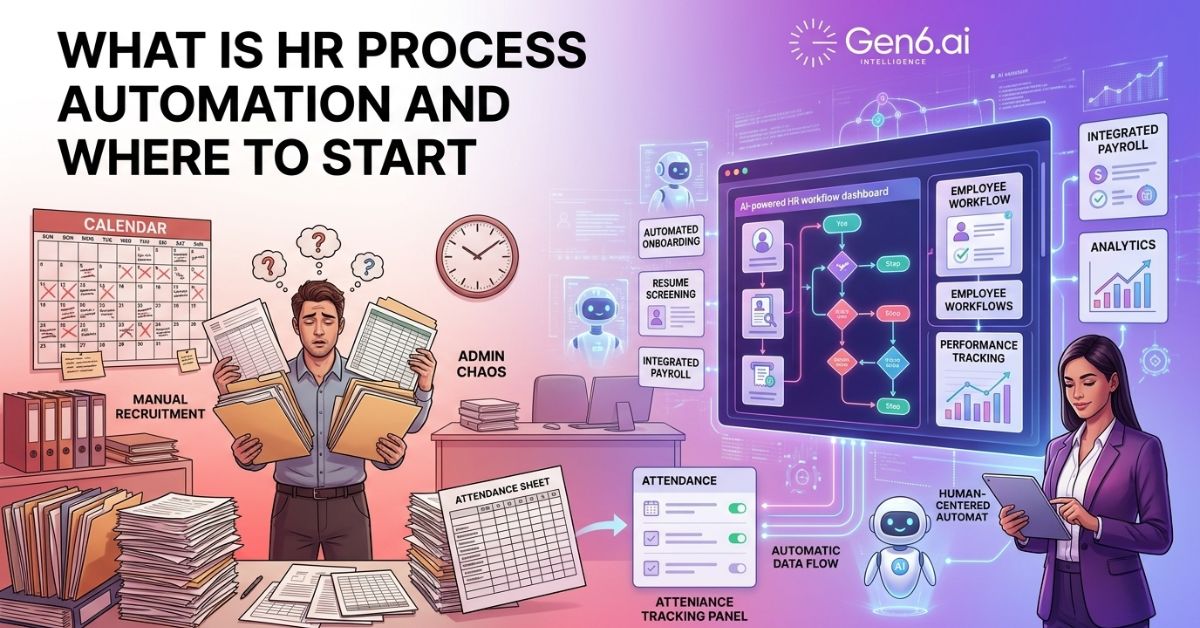
Running a bigger team doesn’t have to mean getting buried in paperwork. HR teams are using more digital tools to get rid of boring, repetitive jobs. By stopping manual data entry, smart companies can work better, save on costs, and have more time to focus on what really matters: helping and growing their employees.
What Is HR Process Automation?
HR process automation uses digital tools to streamline recurring human resources operations via preset rules and triggers. Instead of manually moving files, HR workflow automation passes data cleanly between platforms.
Deploying automated HR services upgrades your business workflows instantly:
- Eliminates manual entry bottlenecks by updating worker profiles across databases.
- Saves precious staff time by handling data filing and routine tracking logs using AI HR automation.
- Trims monthly overhead costs by increasing team output without new hiring.
- Keeps compliance files accurate by removing common human typing errors, a core benefit of automated HR services.
Tugela People data shows that standard HR departments spend 40% to 60% of their time on manual tasks. For a deeper look into how digital workflows reshape daily operations, explore our comprehensive What is HR Automation Guide. Automation solves this issue, handling routine tech logistics so your team can focus on company culture.
Why HR Teams Are Automating in 2026
Switching to AI HR automation helps companies protect thin operating margins. McKinsey notes that employees lose 59 days a year to administrative work, while Gartner finds that strategic automation lowers overall operating costs by up to 30%.
Using modern HR automation solutions fixes major organizational problem areas:
- Slow onboarding speeds that cause prospective hires to reject contract offers.
- Frequent payroll mistakes that damage worker trust and spark audit issues.
- High internal burnout rates are driven by endless, boring spreadsheet data entry.
- Fragmented tracking history that makes business performance reporting difficult.
An automated HR system run by Gen6 AI agents completes these exact tasks right away, without custom software coding.
Which HR Workflows Should You Automate First?
A common mistake is trying to change everything all at the same time. The best teams start by doing simple and easy tasks that happen a lot before moving on to more complicated ones.
The table below outlines the optimal priority order for deploying HR workflow automation using Gen6 AI agents.
| Priority | HR Workflow | Automation Benefit | Gen6 Feature |
| 1 | Employee Onboarding | Cuts setup time from days to hours | Automated onboarding workflows |
| 2 | Payroll & Leave Queries | Reduces manual errors, 24/7 response | Conversational AI bot |
| 3 | Document Verification | Eliminates the manual review bottleneck | Document workflow automation |
| 4 | Policy & SOP Queries | Instant answers from internal data | Internal KB automation |
| 5 | Performance & Reporting | Real-time dashboards, no manual work | Analytics + report automation |
Table: Automated HR services implementation roadmap matrix for operations teams.
What to Look for in an HR Automation Platform
There are certain features that you need in an HR automation platform for your business, including dashboards, mobility, open API, a clean audit trail, and workflow design. Evaluating HR Automation Software for Modern Teams helps ensure your tech stack matches these exact needs.
When evaluating external HR automation solutions, check for these items:
- Simple Stack Integration: Must link with your existing tools without coding, a core advantage of HR automation solutions.
- On-Demand Scalability: System architecture should align with transaction volumes that increase with headcount growth.
- Fast Team Onboarding: The interface should be easy for nontechnical managers to use.
- Enterprise Security Compliance: Continuous logs and secure data handling within an automated HR system.
Remember: automation won’t fix bad processes. If a workflow is broken, software just runs it badly faster. Refine your manual setup first, then use Gen6 AI to scale it.
Our no-code agent builder lets you outline workflows in plain text, link apps, and go live in minutes.
How Gen6 Intelligence Powers AI HR Automation
Gen6 is an intelligent workspace platform built for comprehensive AI HR Automation across talent acquisition, core human resources, and business operations.
Using our specialized HR automation platform simplifies back-office administration:
- Onboarding Automation: Collects files, builds credentials, and shares info automatically.
- Payroll & Leave Queries: Pulls rules from safe internal logs to resolve employee questions.
- Document Verification: Quickly scans and organizes compliance files using automated HR services.
Gen6 functions on a clear Describe → Connect → Launch system, bypassing the IT queue. Security is built in with data encryption, SSO access, audit tracking, SOC 2 compliance, and BYOK capabilities.
HR Automation vs Manual HR: Real Cost Comparison
Is investing in dedicated HR automation solutions worthwhile? Let’s check the operational numbers against Gartner’s 30% savings benchmark.
Automated HR system setups beat manual management across every core corporate metric:
- Admin Time Commitment: Drops from 60% of team hours down to zero for routine data updates.
- New Hire Setup Speeds: Cuts down candidate processing times from weeks to a couple of hours.
- System Database Accuracy: Trades high manual typing risks for error-free automated processing.
- Company Growth Capacity: Replaces costly linear personnel hiring with flexible digital agents.
- Operational Help Windows: Extends basic daytime customer help to 24/7 continuous internal assistance.
Gen6 offers a full free plan with unlimited testing time to get you started smoothly.
How to Start Your HR Automation Journey
Follow this proven five-step framework to transition to an efficient HR process automation model smoothly.
1. Audit Your Current Workflows
Make sure you keep track of the scheduling for your team for the week, for seven days. Determine the three biggest factors that waste time and hinder your management from making key decisions and plans.
2. Define Clear Objectives
Define measurable objectives for your test program. As an instance, in the first month after implementation, set an objective to reduce by half the amount of time needed for onboarding staff.
3. Choose the Right Platform
Select an HR automation platform that does not require any technical knowledge and that integrates easily with other existing tools. This will let your HR team manage the software independently.
4. Run a Focused Pilot
Do not attempt to migrate every department simultaneously. Launch one high-impact workflow first. We highly recommend starting with the new hire onboarding.
5. Track, Measure, and Expand
Monitor your performance dashboard to prove your return on investment. Once your first workflow runs smoothly on your automated HR system, expand your automation rules to cover payroll queries, compliance tracking, and performance management.
You can do every part of this setup process right in our platform without having to spend any money.
Conclusion
Using HR automation is no longer optional; businesses need to stay competitive. By reducing paperwork, tools like Gen6 Intelligence and strategic HR workflow automation help your team concentrate on growing and building a good team spirit. Looking to revamp your workplace? Sign up for our free service and get your first process automated within minutes.
FAQs
1. What HR processes can be automated?
You can automate onboarding, payroll management, leave tracking, document verification, and routine policy query responses.
2. How do I start automating HR in a small company?
Audit your current workflows, select one high-volume task like onboarding, and launch a no-code pilot program.
3. Does HR automation replace HR staff?
No. It eliminates tedious administrative paperwork, freeing your team to focus on culture, talent strategy, and growth.
4. What is the ROI of HR process automation?
It lowers operating costs by up to 30%, slashes onboarding times, and eliminates expensive human data-entry errors.
5. Which HR tasks take the most time and should be automated first?
Manual data entry for employee onboarding and payroll queries takes the most time and should be prioritized first.