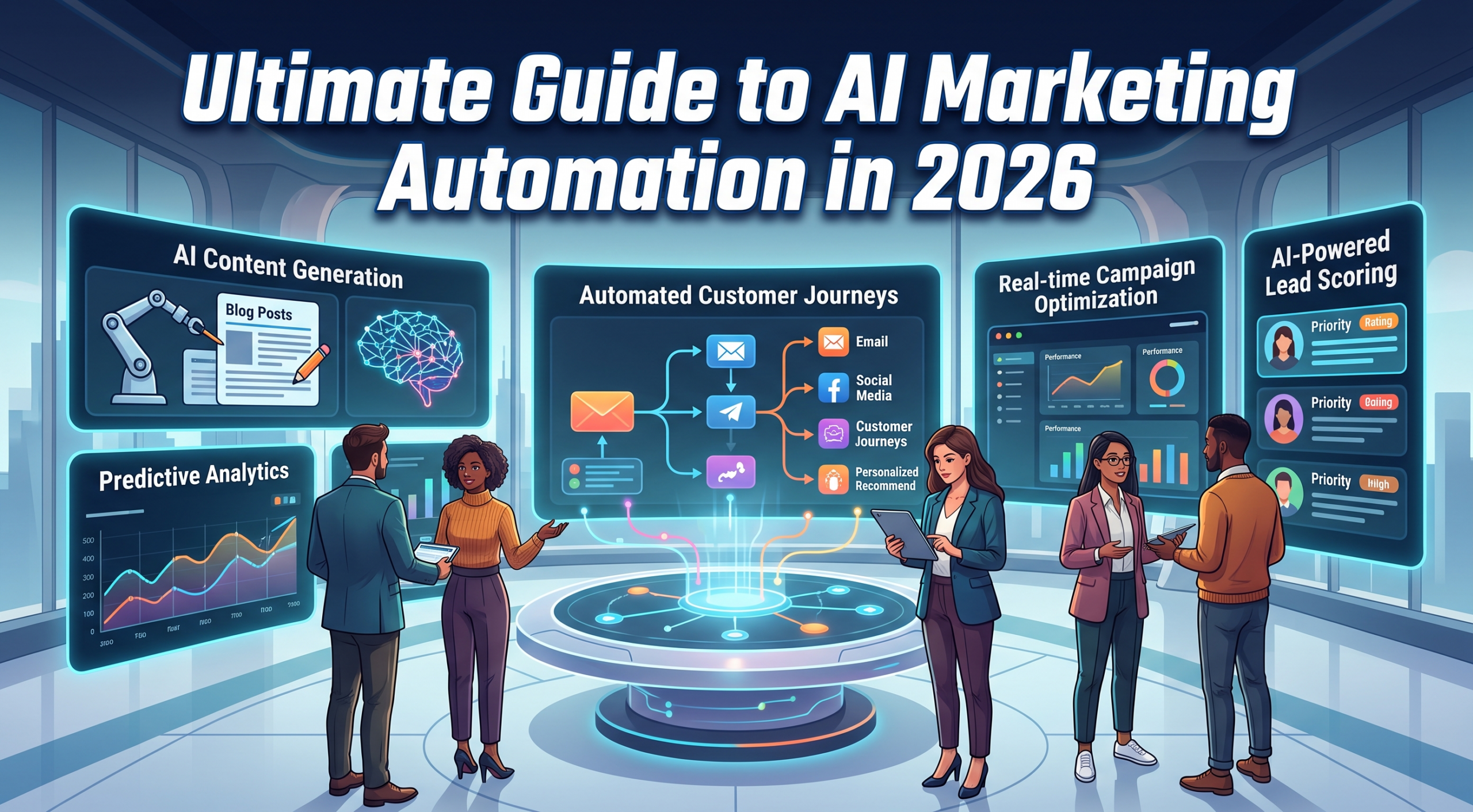
Customers want a personalized experience every time they interact, whereas marketing teams require attracting more leads with fewer resources. See AI marketing automation not only as a means but as an instrument for making your business successful. Selecting the appropriate technology is crucial for enterprises of any size, allowing small teams to locate valuable customers and complete their work fast without burning out.
What Is AI Marketing Automation?
At its core, AI marketing automation refers to smart software that uses machine learning and natural language processing capabilities to assist marketing tasks and optimize their performance. While traditional marketing automation operates through predetermined actions, like sending an email three days after a user downloads a certain PDF. In contrast, AI marketing automation software analyzes customer behavior to make its own decisions.
Consider an e-commerce platform where a traditional tool groups all users who abandon their shopping cart into one single group. With the help of an AI-based solution, that same group can be instantly re-segmented depending on predictive purchase intention, previous browsing speed, and discount sensitivity. More details on key abilities in our AI Marketing Automation.
How AI Marketing Automation Works (Step by Step)
Understanding AI in marketing automation can help you understand the workings of these software programs. To see how these platforms actually operate behind the scenes, look at this continuous five-step cycle
- Data Collection: CRM systems, website tracking, email activity, and ad platforms all provide consistent customer information to the system.
- Pattern Detection: Machine Learning models analyze patterns and determine correlations between behavioral trends and browsing history, open rate, and click timing.
- Prediction & Scoring: The technology determines lead scores dynamically, predicts customer churn potential, and offers next best action suggestions.
- Automated Execution: The platform triggers dynamic content creation, optimized timing, and multi-channel distribution without any human intervention.
- Continuous Learning: Models get automatically retrained based on new conversion results, which increases targeting precision with every campaign that you run.
Key Features to Look For in AI Marketing Automation Tools
When analyzing the top AI marketing automation tools, look for those that have advanced characteristics differentiating real AI-powered marketing automation from regular email tools.
| Feature | Why It Matters |
| Predictive lead scoring | Prioritizes sales follow-up automatically based on conversion probability |
| Dynamic personalization | Tailors website and email content per visitor in real time |
| Behavioral triggers | Reacts to micro-actions and intent signals, not just fixed calendar schedules |
| Multi-channel orchestration | Keeps messaging consistent across email, SMS, paid ads, and on-site chat |
| AI copy & creative assist | Speeds up campaign production with smart variations and subject line testing |
| Predictive analytics | Surfaces “what to do next” actionable insights, not just lagging dashboards |
Explore our breakdown of top choices in our Best AI Marketing Automation Tools Guide.
Benefits of AI Marketing Automation
The benefits of AI marketing automation go well beyond mere time savings. Utilization of marketing automation AI allows for getting much more out of small teams.
- Massive Time Savings: Cuts down hours spent building campaigns, sorting lists, and wrestling with tracking spreadsheets
- Higher Conversion Rates: Offers messages that are tailored to fit each customer’s requirements.
- Smart Lead Prioritization: Ensures that sales reps make contact with customers who are willing to buy and not cold leads.
- Lower Acquisition Costs: Saves unnecessary spending on advertisements through constant targeting improvement.
- Operational Consistency: Provides reliable and personalized communication without recruiting additional employees.
The biggest benefit is compounding; the better your models get at consuming campaign data, the more accurate they become.
Top Use Cases for AI-Powered Marketing Automation
Practical marketing automation for lead generation and customer retention entails the use of intelligent workflows through various channels:
- Email Marketing: Use send-time optimization to reach out to individual email boxes during the times when users are most likely to open, along with dynamic subject line testing.
- Lead Generation & Scoring: Identify and qualify the inbound leads immediately, directing highly qualified leads to the sales team.
- Paid Media Targeting: Build the lookalike audience and automatically reallocate budgets to the highest performing ads.
- Multi-Touch Nurturing: Send out drip campaigns, which dynamically change based on the engagement of the leads with your content.
- Customer Retention: Automatically identify at-risk behavior patterns and activate automated retention programs to win customers back before cancellation.
Dive deeper into growth strategies with our guide on AI Marketing Automation for Lead & Sales Growth.
AI Marketing Automation Software vs Traditional Marketing Automation
| Dimension | Traditional Automation | AI Marketing Automation |
| Trigger Logic | Fixed rules (if X, then Y) | Learns and adapts continuously from data |
| Personalization | Broad segment-level | Individual-level, real-time tailoring |
| Send Timing | Manually scheduled batch sends | Predicted per-recipient delivery |
| Lead Scoring | Manual point systems | Predictive, self-improving algorithms |
| Optimization | Requires manual A/B testing | Continuously self-optimizing workflows |
While traditional automation works well for basic, predictable workflows, smart software introduces the adaptive intelligence needed for modern, fast-paced markets. For a deeper look at how data structures fit together, read our guide on CRM, Sales, and Marketing Automation.
How to Choose the Right AI Marketing Automation Platform
Choosing an AI marketing automation platform requires consideration of more than just the marketing promises and instead paying attention to the infrastructure:
- Data Stack Audit: Make sure that the platform connects seamlessly with your existing CRM, data warehouse, and customer support systems.
- Ask for Transparency: See whether the platform gives AI recommendations that can be explained for your team’s benefit.
- Check the Channel Support: Verify that the software is able to support all of the channels that your current audience uses, including email, SMS, and LinkedIn.
- Review Migration Support: Look for the vendors that will help you migrate away from your old systems.
- Prioritize Data Privacy: It’s important to make sure that you have the proper compliance standards and that customer data is processed in the right way.
Conclusion
AI marketing automation is not only an additional opportunity, but a necessity for effective growth. With the help of predictive analysis and personalized approaches, you can expand your operations and reduce acquisition costs. Embrace these smart technologies now to make your marketing operations future-proof.
Gen6 AI transforms customer behavior data into higher conversions and unmatched growth through predictive, real-time marketing automation.
FAQs
1. What is AI marketing automation?
Machine learning software that performs and optimizes marketing functions automatically.
2. How does AI marketing automation work?
It gathers information, identifies trends, forecasts scores, carries out tasks autonomously, and keeps learning.
3. What are the benefits of AI marketing automation?
Large savings in terms of time, high conversion rate, intelligent lead management, low cost to acquire a customer, and reliable operations.
4. Is AI marketing automation worth it for small businesses?
Yes, it allows small teams to expand their capacity, make effective use of advertising budget, and contact individuals personally without having to hire more employees.
5. What’s the difference between marketing automation and AI marketing automation?
Traditional tools rely on inflexible “if-then” rules, while the AI-based tools can learn and adapt autonomously using real-time data.
6. How much does AI marketing automation cost?
The pricing varies depending on the set of needed features, the number of contacts, and the extent of integration with CRM. Numerous flexible platforms offer pricing models that depend on the tiers or usage.
7. Which tasks can AI marketing automation handle?
Lead scoring, email sequence sending, segmentation by interests, enhancing advertisements, and outreach via various channels.