
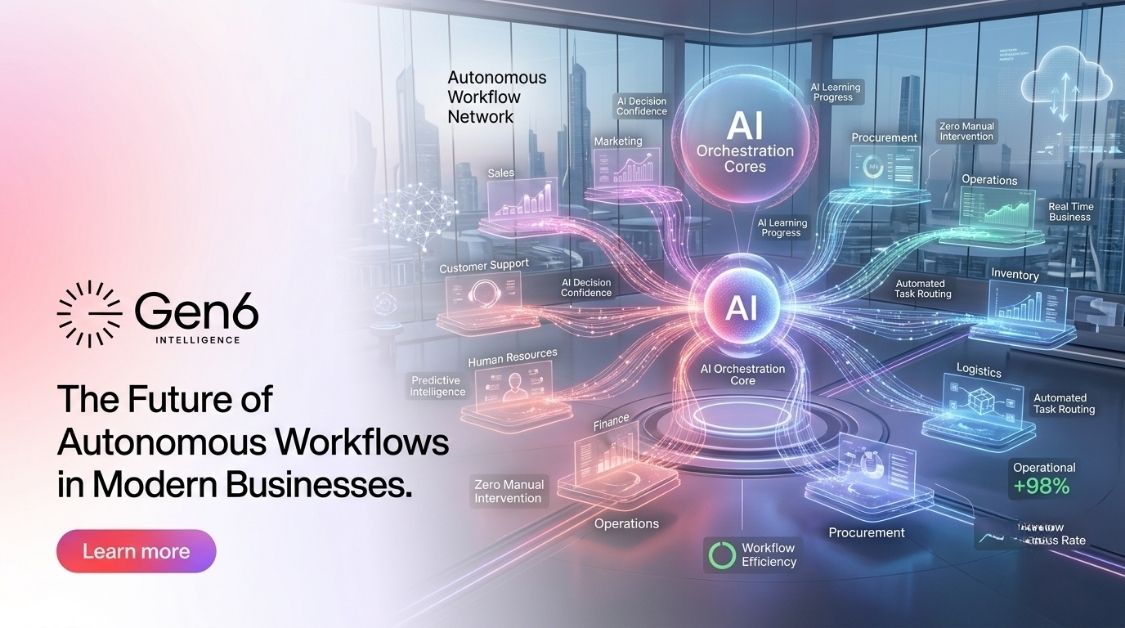
Due to increasing complexity in business processes, the use of basic automation systems becomes insufficient. The future lies in autonomous workflow, where intelligent systems operated by artificial intelligence are capable of reasoning, adapting, and solving problems. By moving from strict, set procedures to flexible and adaptable management, companies are achieving greater growth, better efficiency, and more strategic freedom in all areas.
Why Businesses Are Moving Toward Autonomous Workflows
Traditional automation methods that follow strict rules are having a hard time meeting the needs of today’s businesses. As businesses grow, basic scripts fail due to special situations, causing delays that need regular manual fixes.
- Handling Complexity: Not like static scripts, such systems can handle exceptions and variances in real time.
- Operational Efficiency: These enable 24-hour operations, allowing staff to boost production without any additional manpower.
- Strategic Focus: By leaving routine decisions to smart machines, the workforce can concentrate on more strategic decisions.
- Scalability: Enterprises are now embracing hyperautomation to move beyond simple scripted tasks toward fully self-running business workflows.
Autonomous Workflows vs Traditional Automation: Quick Comparison
The future of workflow automation relies on going beyond strict, straight-line processes. While legacy RPA excels at simple data entry, agentic workflows introduce reasoning to the process. To understand the shift in how AI agents function compared to traditional tools, consider the table below:
| Capability | Traditional Automation (RPA) | Autonomous Workflows (Agentic) |
| Decision-making | Fixed rules only | Context-aware, adaptive |
| Handles exceptions | No: requires human handoff | Yes: agents reason and resolve |
| Learns over time | No | Yes, via feedback loops |
| Coordination | Single script, single task | Multi-agent systems, multi-step |
| Human involvement | Constant oversight | Human-in-the-loop for edge cases only |
How AI Agents Power Autonomous Decision-Making
The core shift in AI agents’ autonomous automation is the move from “executing” to “deciding.” These agents analyze the environment and find the best way to proceed rather than just following instructions.
- Layered Reasoning: The agent considers the data, context, and actions that took place previously before deciding on a reaction.
- Adaptive Learning: They receive feedback from the system and therefore learn from mistakes made earlier and improve the routing and decision-making process.
- Context Sensitivity: The agent understands the business environment and therefore can escalate or fix problems depending on confidence levels.
- Proactive Management: This allows for independent decision-making, making automation an active partner in your work.
Agentic Workflows in Action: Real Business Use Cases
Agentic workflows are most effective in areas characterized by high variability. They succeed where traditional automation historically fails because they can interpret and react to unique circumstances.
- Finance: Agents match complex invoices and resolve discrepancies without needing a manual review queue.
- Customer Support: Systems deliver multi-phase resolutions from multiple platforms, offering complete resolutions rather than quick fixes.
- Operations: Supply chain employees continually monitor inventory levels and automatically reroute orders when a disruption occurs
- HR: Onboarding processes adapt document collection and workflows based on individual employee roles and local regulations.
Hyperautomation and Self-Healing Workflows: What’s Next
The future of business operations is defined by hyperautomation, an overall self-learning operating model. For those looking to master these modern workflow management systems, the focus is on creating resilient, intelligent loops.
- Self-Healing Capabilities: The self-healing workflow detects any failure midway through execution and automatically retries or re-routes.
- Reducing “Silent Failures”: Gen6 helps coordinate different parts of your system, stopping problems that often happen when using separate tools.
- Enterprise Integration: This technology helps bring together different tools into one smart system.
Multi-Agent Systems and the Human-in-the-Loop Question
Using multi-agent systems doesn’t mean getting rid of supervision. Instead, it means giving tasks to others while keeping overall control of the plan.
- Specialized Roles: Complicated tasks are split up among different workers who are responsible for finding information, thinking through problems, and carrying out actions to make things more dependable.
- Intentional Oversight: A person helps make important decisions to ensure the AI follows safety rules.
- Compliance and Audits: Companies have complete visibility of their decision-making process, which is critical for heavily regulated businesses.
- Reliable Autonomy: The objective is not “autonomy” but “reliable autonomy” to give peace of mind and faster results.
The Future of Workflow Automation: What to Expect Beyond 2026
The future of workflow automation is moving towards better connections with other systems. We expect to see more collaboration between different AI systems and platforms.
- Standardization: Look for new rules to help agents communicate with each other better, making it easier for businesses to connect their systems.
- Regulatory Maturity: Better rules for following laws will help more people use smart AI in important areas.
- Observability: Gen6 is focusing on providing the diagnostic tools needed to monitor autonomous AI workflows as they scale.
How Gen6 Helps Businesses Build Autonomous Workflows
We create the system that makes your agents work. Gen6 helps you connect design and production.
- Unified Orchestration: Create, set up, and keep an eye on your agents for all business tasks from one location.
- Rapid Deployment: You can begin utilizing your first agent more quickly thanks to pre-made connections for widely used business software.
- Secure Governance: You can maintain compliance by auditing using log monitoring and human-in-the-loop controls.
- Scalable Architecture: Develop flexible processes that evolve with your company.
Start Building Autonomous Workflows with Gen6 →
Conclusion
Autonomous workflows change how companies work by transforming strict processes into flexible and smart systems. By using advanced technology and automation, companies can improve their ability to adapt and respond quickly, moving past just completing basic tasks. The future will be for those who use trustworthy automation in their main business plans now.
FAQs
What is an autonomous workflow?
A self-governing business process using AI agents to execute end-to-end tasks without constant human intervention.
How are autonomous workflows different from traditional automation?
Traditional tools follow rigid, pre-programmed rules; autonomous workflows use AI to reason, adapt, and resolve exceptions.
Are autonomous AI agents safe for business use?
Yes, when paired with robust governance platforms, human-in-the-loop checkpoints, and audit trails for compliance.
What industries are adopting autonomous workflows first?
Finance, customer support, IT operations, and supply chain management are leading early, high-impact adoption.
What does the future of workflow automation look like?
A transition toward unified, multi-agent orchestration systems that connect fragmented enterprise tools into one intelligent layer.